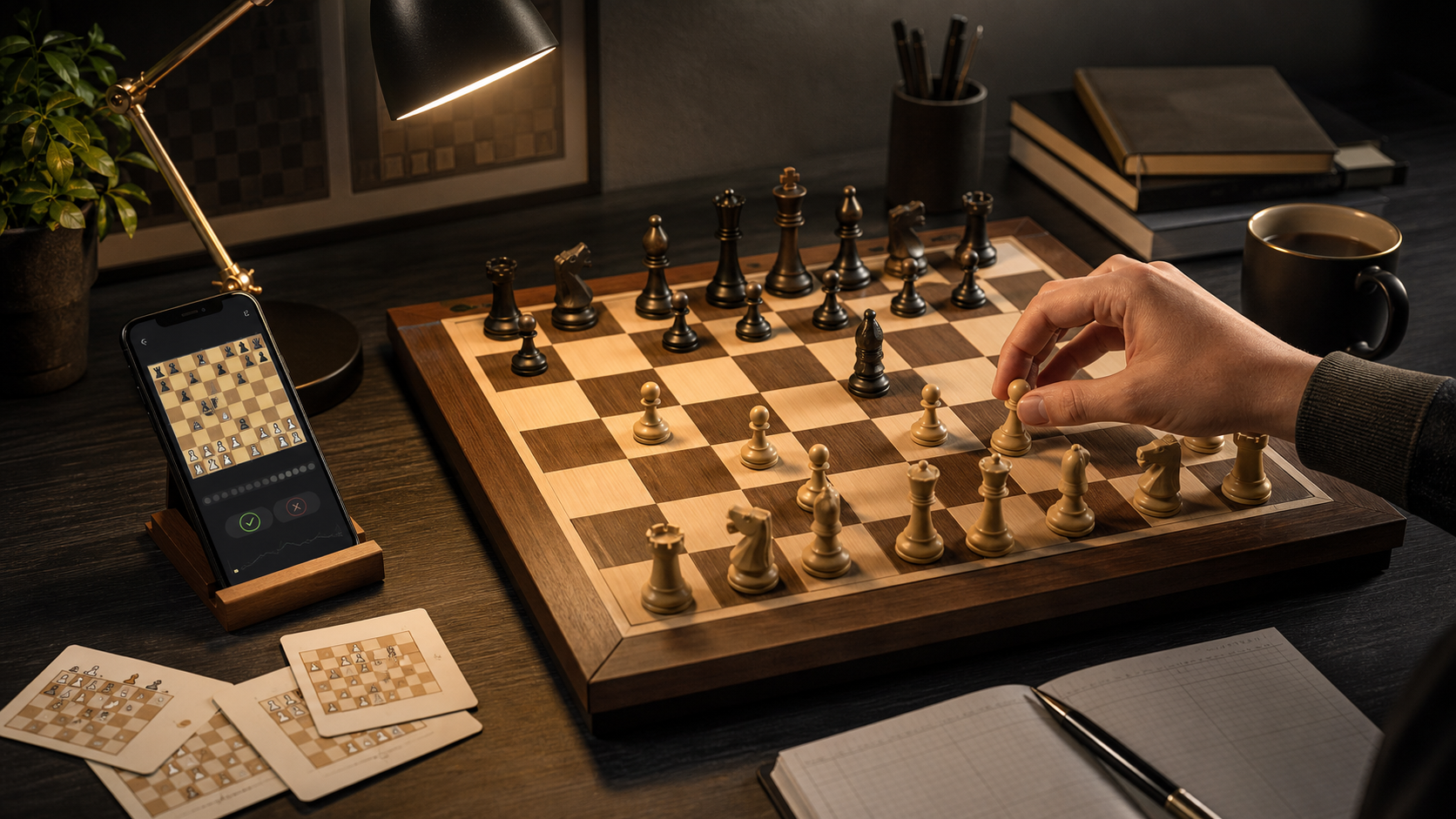
Most opening study is recognition practice in disguise. You replay a line, nod because the next move looks familiar, and feel like the position is stored. Then a real game starts, your opponent reaches the same structure through a slightly different move order, and the move does not arrive.
That failure is not random. Recognition and recall are different skills. Recognition asks, "Have I seen this before?" Recall asks, "What is the move, right now, without a hint?" Chess rewards the second skill. Active recall is the method that trains it.
Do not study openings as finished lines. Study them as board positions that ask a question. The question might be the next move, the plan, the threat, or the critical mistake to avoid.
Why Passive Opening Review Fails
Passive review feels smooth because it removes friction. The move is visible, the engine arrow is present, or the video presenter explains the idea before you have to search. That makes the session pleasant, but it also removes the exact effort your memory needs.
In opening study, passive review creates three predictable problems:
- False fluency. A line feels easy because each move cues the next one. In a game, those cues disappear.
- Move-order fragility. You remember a sequence, but not the position. A transposition breaks the chain.
- Weak error detection. You know the main line, but cannot recognize the moment when a natural-looking move is wrong.
This is why players often say, "I studied this," right after missing it. They did study it. They just studied it in a way that trained recognition instead of retrieval.
What Active Recall Means for Chess Openings
Active recall means you see a position and must produce an answer before getting feedback. For chess openings, the answer is usually a move, but it does not have to be only a move. Strong opening memory includes several layers:
| Prompt type | Question | Why it matters |
|---|---|---|
| Move recall | What is the next move? | Builds fast, game-ready retrieval. |
| Plan recall | What is the idea behind the move? | Prevents rote memorization from collapsing after deviations. |
| Danger recall | What should I avoid here? | Protects against traps and natural mistakes. |
| Transposition recall | Which known line did this become? | Connects similar positions instead of storing them separately. |
A good active recall prompt is specific enough to grade. "Understand the Italian Game" is not a prompt. "After 1.e4 e5 2.Nf3 Nc6 3.Bc4 Bc5, what move keeps the quiet Italian plan flexible?" is a prompt.
Turn Lines Into Board Prompts
The simplest way to improve your opening study is to stop saving only full variations. Break each variation into decision points. A decision point is a position where your next move matters, where opponents often deviate, or where the plan changes.
Use this conversion process:
- Write the line once. Keep the full sequence so the opening remains connected.
- Mark the first unfamiliar move. That is usually your first recall prompt.
- Mark every branch point. If Black can choose between two serious replies, both positions deserve prompts.
- Add one plan note. The move should not stand alone. Attach the idea that makes it memorable.
- Add one danger note. If there is a common trap or bad natural move, make it explicit.
For example, suppose you are studying the quiet Italian: 1.e4 e5 2.Nf3 Nc6 3.Bc4 Bc5 4.c3 Nf6 5.d3. The prompt is not "memorize the first five moves." Better prompts are: "Why does White play c3 before d4?", "What changes if Black plays Nf6 before Bc5?", and "Which break is White preparing after castling?"
The Three-Pass Active Recall Loop
A reliable study session has three passes. Each pass should be short. The goal is not to exhaust the opening in one sitting; it is to create durable retrieval paths.
Pass 1: Encode the Idea
First, learn the line normally. Look at a book, course, database, or model game. Ask what each move is doing. If the move only exists because "the course says so," your recall will be fragile.
Pass 2: Retrieve From the Board
Close the source. Put the position on the board. Try to find the move without hints. If you miss it, do not immediately restart the line. Pause and identify the confusion: wrong candidate move, forgotten move order, missed opponent threat, or missing plan.
Pass 3: Review With Spacing
After the first session, stop rereading the line every day. Put each prompt into a spaced repetition system. Easy positions should return later. Missed positions should return sooner. This is where active recall becomes scalable rather than exhausting.
If you want the science behind the timing, read our guide to spaced repetition for chess opening memorization. The short version: recall strengthens memory most when it happens near the edge of forgetting.
A Practical Italian Game Example
Here is how a small opening fragment can become a useful recall set:
| Position | Recall prompt | Good answer |
|---|---|---|
| 1.e4 e5 2.Nf3 Nc6 3.Bc4 Bc5 | What is White's flexible setup move? | 4.c3, preparing d4 while keeping a strong center. |
| After 4.c3 Nf6 | What quiet move supports the center? | 5.d3, keeping the position solid before expanding. |
| After castling | What central break is White usually preparing? | d4, when the pieces are ready to support it. |
| Black delays castling | What should White check before automatic moves? | Whether a central break or tactical pressure is available. |
Notice that only two prompts are pure move recall. The others test plans and dangers. That is intentional. Real games rarely ask you to recite a line from move one. They ask you to recognize a position and choose.
Practice Openings With Active Recall
ChessRecall turns opening positions into board-based prompts, then uses FSRS-4.5 to schedule reviews before the line fades.
Keep a Mistake Log, Not a Shame List
Missed prompts are the most valuable part of the system. They show exactly where your opening memory is weak. Treat each miss as data, not as proof that you are bad at memorizing.
Use four labels for mistakes:
- Forgotten move: you understood the position but could not produce the move.
- Confused line: you played a move from a similar variation.
- Plan missing: you remembered the move but not why it works.
- Opponent threat missed: you ignored the reason the move was necessary.
The label determines the fix. A forgotten move needs another board prompt. A confused line needs comparison with the similar variation. A missing plan needs one sentence of explanation. A missed threat needs a danger prompt.
Common Active Recall Errors
Active recall is simple, but players often dilute it until it becomes passive review again.
- Using hints too early. If you see the first letter, the engine move, or the next position, the retrieval has already been weakened.
- Testing only main lines. Opponents do not cooperate. Add common deviations before rare depth.
- Ignoring plans. A move without a reason is easy to confuse with a nearby line.
- Reviewing too soon. Repeating a line five times today is less useful than recalling it tomorrow, in four days, and next week.
This is also why memorizing openings faster does not mean forcing more moves into one session. It means making each review do more work.
Build a Weekly Maintenance Rhythm
Once your recall prompts exist, maintenance becomes straightforward. Do not rebuild your repertoire every week. Let your reviews show what needs attention.
- Daily: clear due review prompts, even if the session is only ten minutes.
- After games: add one prompt for the first opening position where you were unsure.
- Weekly: inspect missed prompts and add plan or danger notes where needed.
- Monthly: prune rare lines that never appear and deepen the lines you actually reach.
This rhythm keeps study connected to real games. You are not memorizing theory for its own sake. You are strengthening the positions that repeatedly decide your openings.
The Bottom Line
If you want opening knowledge that survives real games, stop measuring study by how many moves you watched. Measure it by how many positions you can solve from the board without help.
Active recall turns openings from fragile sequences into usable chess knowledge. Add spacing, and those positions stay available for weeks and months instead of disappearing after the next video. That is the difference between having studied an opening and being ready to play it.