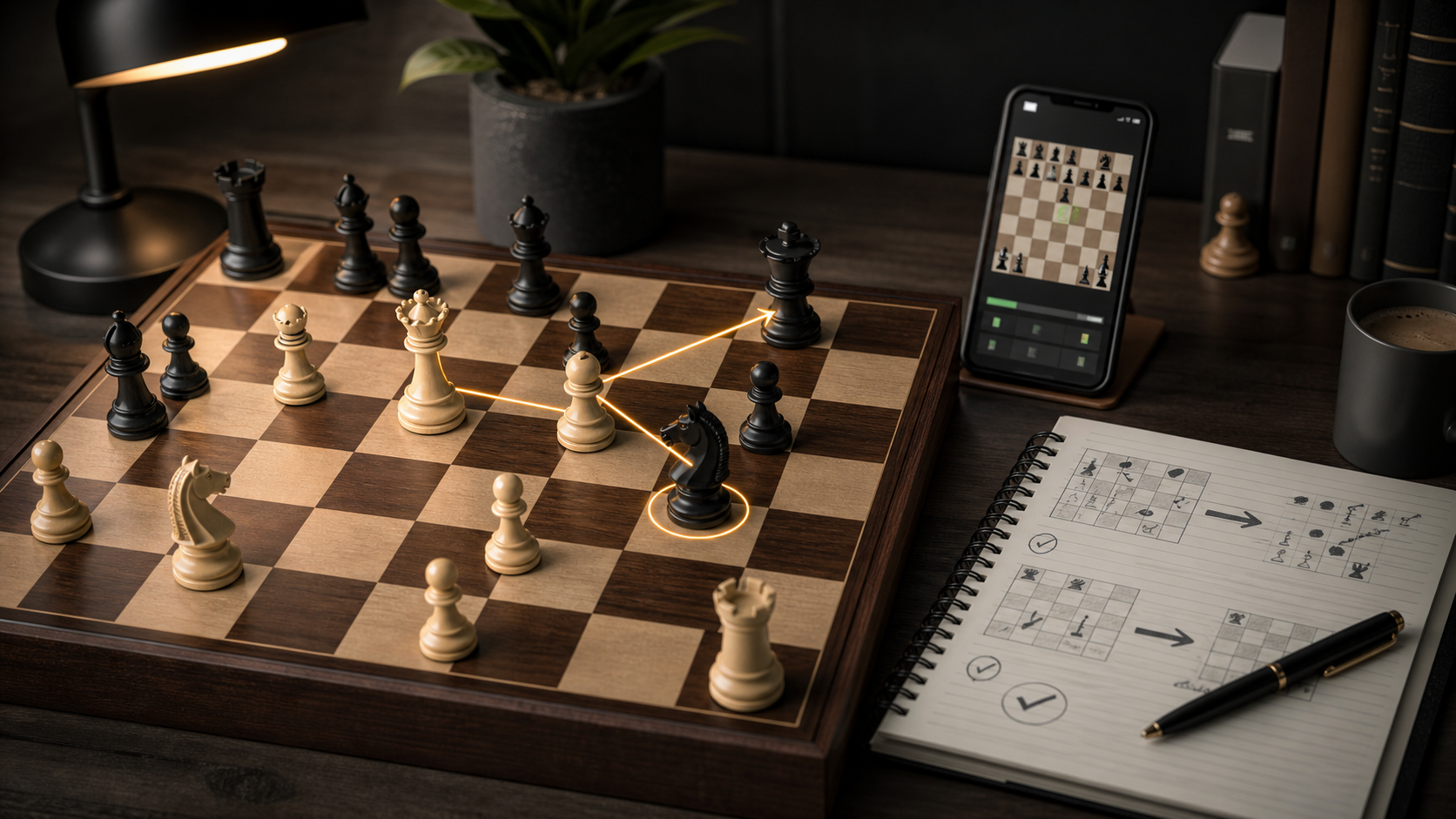
Chess opening traps are tempting to study as party tricks. You learn a forcing line, hope your opponent walks into it, and feel prepared. Then the game starts, the move order is slightly different, and the trap vanishes. Worse, you may chase the trick anyway and end up worse.
The problem is not that opening traps are useless. The problem is that most players memorize them at the wrong level. A trap is not a string of moves. It is a pattern: a loose piece, an overloaded defender, a king stuck in the center, a diagonal that should not open, or a natural move that fails tactically.
Remember chess opening traps by storing three things: the danger signal, the forcing move, and the safe response if the trap does not appear.
Why Opening Traps Are So Easy to Forget
Opening traps are fragile memories because they often depend on exact move orders. You may remember that a queen sacrifice works somewhere in the line, but not which defender had to be removed first. You may remember a knight fork, but not the quiet move that made the fork possible.
There are four common failure modes:
- You remember the finish, not the setup. The final tactic is vivid. The warning signs that create it are not.
- You ignore the opponent's best defense. A trap is only useful if you know what happens when your opponent avoids it.
- You study too many traps at once. Similar motifs blur together, especially in sharp openings.
- You review by replaying the line. Recognition makes the trap feel familiar without proving you can find it at the board.
The cure is to convert traps into recall prompts. Instead of asking, "Can I replay this line?" ask, "Can I recognize the position where this tactic becomes possible?"
The Anatomy of a Useful Opening Trap
Every opening trap worth remembering has a structure. If you capture that structure, you can recall the idea even when the exact move order changes.
| Part | Question to ask | Example signal |
|---|---|---|
| Trigger | What opponent move makes the trap possible? | A premature pawn grab or greedy queen move. |
| Target | What is actually vulnerable? | King, queen, loose bishop, pinned knight, back rank. |
| Forcing move | What move gives the opponent no time to escape? | Check, capture, threat, or zwischenzug. |
| Refutation | How does the opponent avoid the trap? | Developing move, exchange, castling, returning material. |
| Fallback plan | What should you play if the trap is not available? | Normal development, center control, king safety. |
The fallback plan is the part most players skip. That is why trap-based opening study becomes dangerous. You should never need your opponent to blunder for your opening to make sense.
Study the Pattern, Not Only the Move Order
Take a common beginner trap: a vulnerable f7 or f2 square in open games. If you memorize only the exact sequence, you will miss the motif when it appears in a different opening. If you learn the pattern, you start seeing the same tactical idea across Italian Game, Scotch, Vienna, and Two Knights positions.
For every trap, write one sentence that explains the pattern without notation:
- The king is stuck in the center and the e-file can open with tempo.
- The knight is pinned, so the defender of a key square is imaginary.
- The queen moved too early and can be attacked by developing moves.
- A bishop and queen battery creates a threat before the defender castles.
These sentences are memory hooks. They also prevent you from playing the trap mechanically. If the pattern is not present, the tactic probably does not work.
Turn Each Trap Into Active Recall Prompts
The best way to remember a trap is to make yourself solve it from the board. Do not show the full line first. Show the critical position and ask a precise question.
Use three prompt types:
- Danger prompt: What did the opponent just allow?
- Execution prompt: What forcing move starts the tactic?
- Defense prompt: What should the opponent have played instead?
This mirrors real chess. In a game, you first need to notice that something changed. Then you need to calculate the forcing move. Then, if the trap is not available, you need to understand why and continue normally.
If this workflow is new, read our guide to active recall for chess openings. The same method works for traps, but the prompts should emphasize danger signals and refutations.
A Practical Trap Study Example
Suppose you are studying a line where Black grabs a poisoned pawn and leaves the king underdeveloped. A poor study note says: "If ...Nxe4, then Re1 wins." That is too thin. You may remember the tactic, but you will not know when it applies.
A better trap card looks like this:
| Field | Study note |
|---|---|
| Trigger | Black takes a central pawn before castling. |
| Danger signal | The king is still in the center and the e-file can open. |
| Prompt | What forcing move punishes the king in the center? |
| Answer | Use a rook or queen move with tempo, then calculate checks and pins. |
| Fallback | If Black has castled or defended, develop and regain the center normally. |
This card is much easier to transfer to real games. You are not waiting for a memorized movie to play. You are checking whether the tactical conditions are present.
Avoid Trap Addiction
Opening traps should make your repertoire sharper, not more brittle. The danger is building an opening around what happens if your opponent plays badly. That works in blitz for a while, then fails as opponents improve.
Use this rule: every trap you study must connect to a healthy main plan. If the trap fails, you should still have normal development, central control, and a playable middlegame.
For example, a trap in the Italian Game is valuable if it also teaches you why development, castling, and central breaks matter. It is less valuable if it asks you to move the queen five times and hope your opponent misses one defense.
If you are still building your core lines, pair trap study with a compact repertoire. Our guide on building a chess opening repertoire you'll remember explains how to choose anchor openings before adding sharper details.
Review Traps Before They Fade
ChessRecall turns opening traps into board-based active recall prompts, then uses FSRS-4.5 to bring them back before you forget the danger signal.
Use a Review Schedule for Trap Memory
Traps fade quickly because they are specific. A tactical shot that looks obvious today may disappear after a week, especially if you have studied several similar lines.
A simple review schedule helps:
- Day 0: Learn the trap and write the danger signal.
- Day 1: Solve the critical position without seeing the move order.
- Day 4: Review the defense and fallback plan.
- Day 10: Mix the trap with similar non-trap positions so you must decide whether it works.
- After that: Let spaced repetition decide the next review based on recall quality.
The mixed review on day 10 is important. If every card is a trap, your brain expects tactics. Real games do not announce when a tactic exists. Include positions where the tempting trap does not work.
What to Do When You Miss a Trap
When you miss a trap in review or in a real game, do not just repeat the line. Diagnose the miss.
- Missed trigger: Add a prompt asking what the opponent's last move weakened.
- Wrong calculation: Add the forcing sequence one move at a time.
- Confused with another trap: Compare the two positions side by side.
- Trap did not work: Add the defender or resource you overlooked.
This is how trap study becomes useful chess training. You are not collecting cheap wins. You are training tactical awareness inside your opening repertoire.
The Bottom Line
Opening traps are worth studying, but only if you study them like chess positions instead of magic spells. The goal is not to surprise every opponent. The goal is to recognize danger signals faster than they do.
Store the trigger, target, forcing move, refutation, and fallback plan. Review the position with active recall. Mix trap and non-trap positions. Do that, and traps stop being fragile tricks. They become part of your opening understanding.